Hospital Disaster Support Communications System



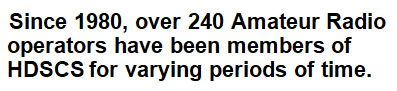
The Hospital Disaster Support Communications System (HDSCS) was a group of Amateur Radio ("ham") operators who volunteered to provide backup internal and external communications for critical medical facilities in Orange County, California whenever normal communications are interrupted for any reason. Starting with just one hospital in 1980, the group soon was supporting seven hospitals in the northern part of the county and eventually had agreements for support with all acute receiving hospitals and some other medical facilities, over 35 in all.
The HDSCS emphasis was always on backing up all forms of hospital communications, both unit-to-unit and from the hospital to community resources. Each member received formal training that was developed by HDSCS, and was expected to have a "go kit" of communications gear ready to respond to any of the supported hospitals. A robust alerting system insured that hospitals could contact HDSCS rapidly when help was needed.
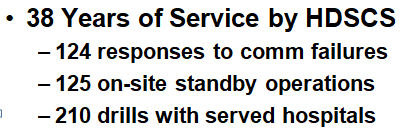
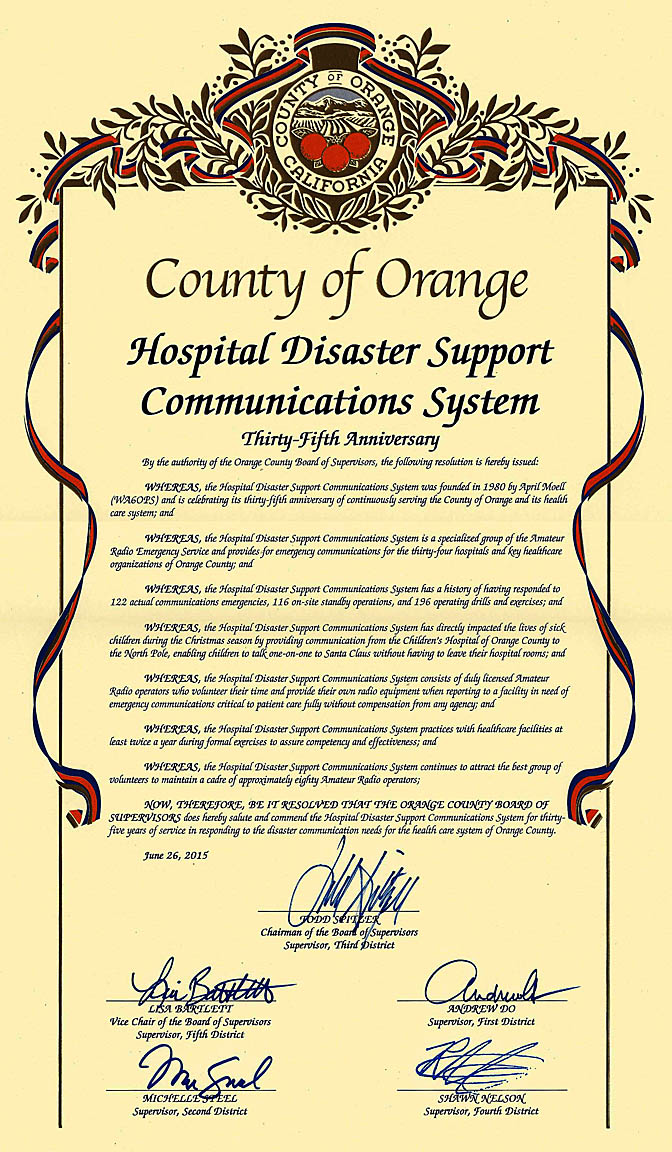
Over 38 years, there would be 124 times that this volunteer group would be activated to support hospitals that were experiencing communications failures. There were 210 drills and 125 standby operations (operations during planned hospital power or communications system cutovers) along the way, too. During this entire time, HDSCS was under the leadership of its founder, April Moell WA6OPS.
In October 2018, continuance of the group become unrealistic for April due to multiple medical issues. While HDSCS members had been dedicated and capable, none had the available time, the requisite experience and the continuing interest to manage a group of Amateur Radio operators under the HDSCS model. Succession plans did not succeed and HDSCS was disbanded.
To the hospital disaster planners and Emergency Medical Services Agency personnel who have worked with us to plan and provide Amateur Radio backup communications, please accept our deep appreciation.
We believe that the HDSCS model under the Amateur Radio Emergency Service (ARES) is the most effective way to perform hospital support, because ARES permits direct contact between the hospitals and the Amateur Radio support group for alerting, without any intervening government agency. Most pages of this Web site remain to explain the HDSCS model and encourage other groups to follow it.
 Cadre of Amateur Radio (AR) operators
Written agreements for support
 Rapid and robust alerting system
Proven communications plan
Ongoing training program
Documents provided to each member, including:
Point system to monitor member activity and reward the most active members
Regular liaison with other emergency preparedness groups in OC (e.g. RACES)
More about HDSCS and Amateur Radio Support to Hospitals
 Supporting Hospitals with Amateur Radio, Your First Steps -- The right way for ham radio groups to get started in supporting their local hospitals
We Got Letters -- Thanks from hospitals we have served and from public officials
How Often Do Hospitals Need Hams, Anyway? -- Our vital statistics and a quiz for you
News Notes -- News of our most recent activities, drills, and emergency activations
"CODE BLUE: Hams and Hospital Emergencies" -- A classic article about HDSCS by Joe Moell
Frequently Asked Questions From Amateur Radio Operators -- April Moell answers inquiries from hams around the country about how best to support their local hospitals
When the Shaking Starts, It's Too Late to Plan -- Equipment and personal preparedness for emergency communications
Amateur Radio Support for Hospitals, A 38-Year Legacy -- How it Began and Early Lessons Learned
Analog Voice, It's Still Best -- A PDF white paper explaining why HDSCS didn't adopt digital and image modes
RF Interference in Hospitals -- Our common-sense approach to avoiding it
Patient Privacy, HIPAA, and Amateur Radio Communications -- HDSCS and medical confidentiality
Annual Orientation and Review Workshop -- A day of learning and V.I.P. recognition
Welcome to K6QEH/R -- The main HDSCS repeater system
North Pole Network -- An annual holiday activity of HDSCS
Supporting Hospitals with Amateur Radio, Your First Steps -- The right way for ham radio groups to get started in supporting their local hospitals
We Got Letters -- Thanks from hospitals we have served and from public officials
How Often Do Hospitals Need Hams, Anyway? -- Our vital statistics and a quiz for you
News Notes -- News of our most recent activities, drills, and emergency activations
"CODE BLUE: Hams and Hospital Emergencies" -- A classic article about HDSCS by Joe Moell
Frequently Asked Questions From Amateur Radio Operators -- April Moell answers inquiries from hams around the country about how best to support their local hospitals
When the Shaking Starts, It's Too Late to Plan -- Equipment and personal preparedness for emergency communications
Amateur Radio Support for Hospitals, A 38-Year Legacy -- How it Began and Early Lessons Learned
Analog Voice, It's Still Best -- A PDF white paper explaining why HDSCS didn't adopt digital and image modes
RF Interference in Hospitals -- Our common-sense approach to avoiding it
Patient Privacy, HIPAA, and Amateur Radio Communications -- HDSCS and medical confidentiality
Annual Orientation and Review Workshop -- A day of learning and V.I.P. recognition
Welcome to K6QEH/R -- The main HDSCS repeater system
North Pole Network -- An annual holiday activity of HDSCS
 Some Activation Reports (Also see Activations 2015 - 2018)
Photo pages
Site Search -- Search the HDSCS and North Pole Network sites by word, name, callsign, or phrase
Some Activation Reports (Also see Activations 2015 - 2018)
Photo pages
Site Search -- Search the HDSCS and North Pole Network sites by word, name, callsign, or phrase
 This page updated 30 August 2023